Materials FAQ · Stainless Steel Food Containers
Why Can Some Stainless Steel Lunch Boxes Go in the Microwave—While Ordinary Ones Cannot?
Electric-field concentration, product geometry, operating limits, and the validation behind “microwave-safe stainless steel”
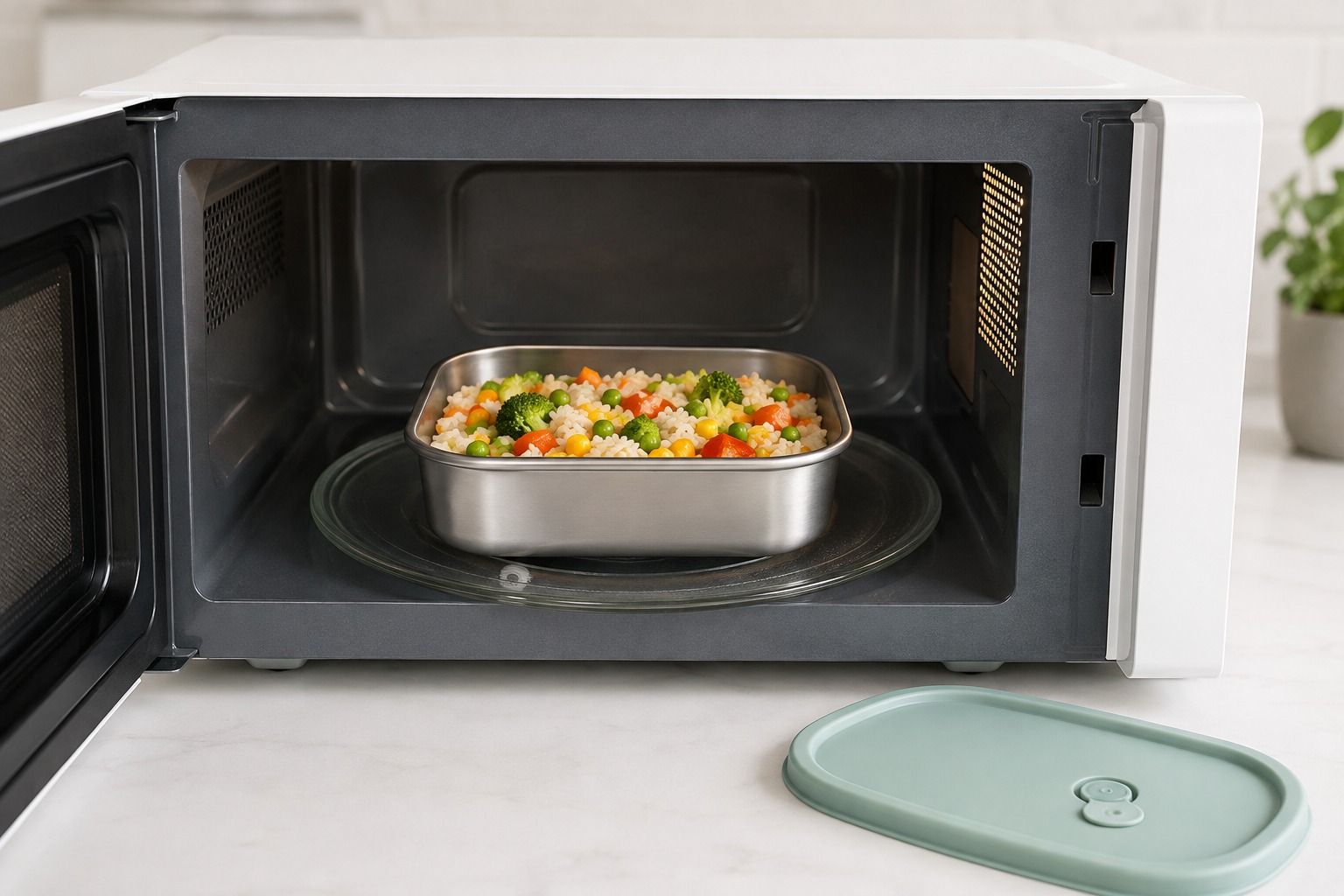 Figure 1. A purpose-designed microwave-safe stainless steel lunch box is safe only within a defined system: container, food load, placement, lid configuration, power, and time.
Bottom line: A microwave-safe stainless steel lunch box does not make microwaves pass through steel. The metal still reflects much of the field and carries surface currents. Safe use comes from smooth, continuous geometry; controlled metal parts and gaps; a suitable opening and overall size; explicit operating limits; and testing for arcing, heating, durability, food contact, and foreseeable misuse. An ordinary unmarked stainless steel lunch box should not be put in a microwave.
1. Metal Does Not Automatically Mean “Instant Sparks”
Household microwave ovens typically operate near 2.45 GHz. Water-rich food absorbs electromagnetic energy and heats up. In metal, free electrons move with the alternating electric field, creating surface currents and reflecting much of the microwave energy back into the cavity. The oven’s own walls are metal, so the useful question is not simply “Is metal present?” but “What shape, position, and combination of conductors has been placed in the field?”
The main hazard is local electric-field concentration. Sharp corners, burrs, thin edges, wrinkles, and narrow gaps between conductive parts can crowd charge into a very small region. If the local field becomes strong enough to break down air, the result may be crackling, sparks, or a sustained arc. Engineering explanations from MIT and experimental research on metal objects in microwave ovens identify edge and tip concentration as a central mechanism. [1][2]
Shielding is the second issue. Microwaves do not readily pass through an intact metal wall. If a container is deep, has a small opening, or remains covered by a metal lid, energy can enter only through a restricted path, causing slow heating or a hot top and cold bottom. USDA guidance likewise notes that food completely enclosed by metal will not heat normally, while certain metal trays designed for microwave use can receive energy through the open top under specified conditions. [3]
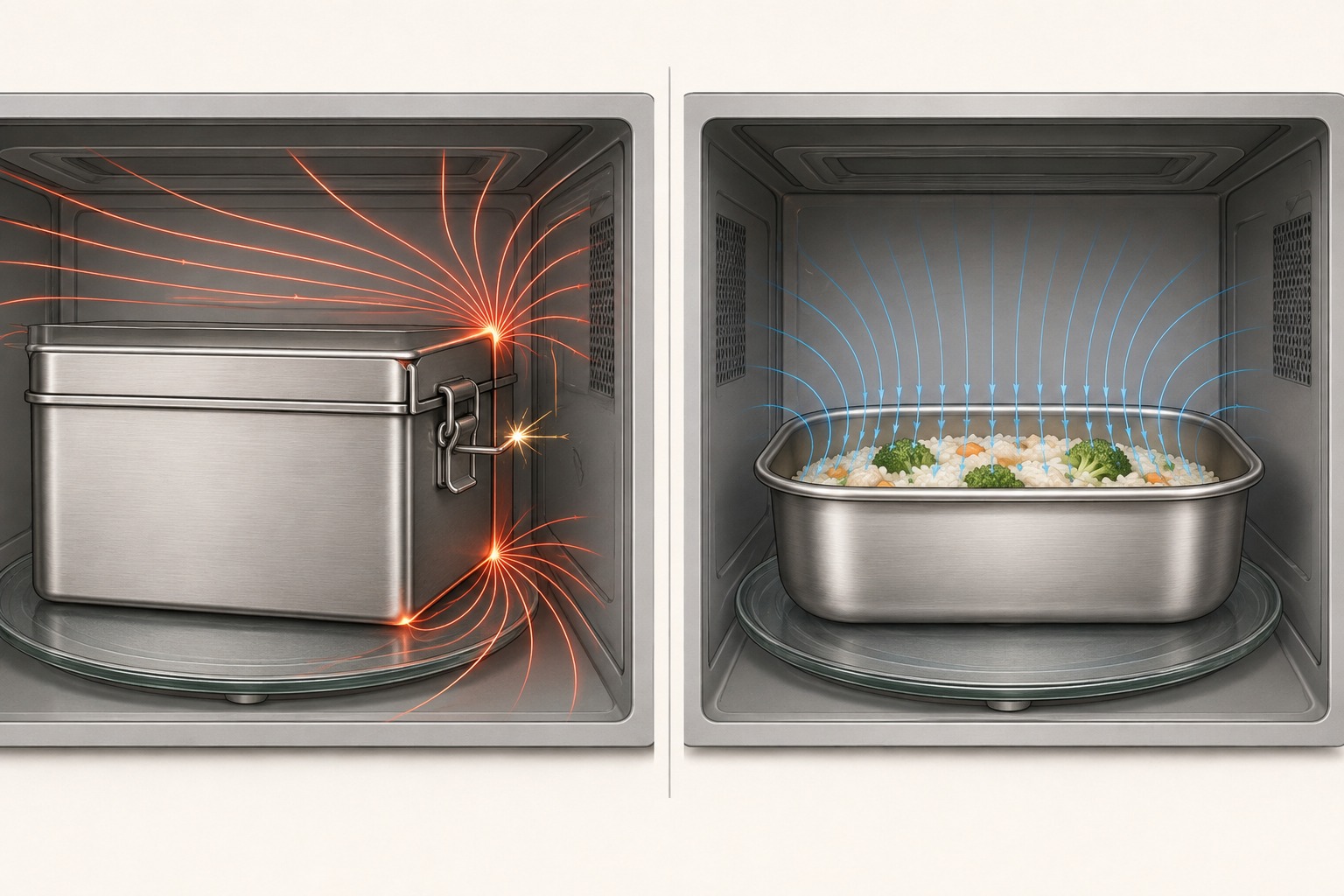 Figure 2. Left: sharp corners, metal latches, narrow gaps, and proximity to the oven wall increase arcing risk. Right: large radii, continuous surfaces, a wide opening, and centered placement reduce risk together.
2. Why Ordinary Stainless Steel Lunch Boxes Are Usually Not Microwave-Safe
An ordinary lunch box is generally optimized for impact resistance, leak prevention, stacking, and cost—not for the electromagnetic environment inside a microwave. It may be perfectly acceptable for storage or transport while still having microwave-unfriendly features:
• Edges and corners: square walls, stamping burrs, thin flanges, or a rolled rim that has been dented or lifted.
• Separate metal parts: latches, hinges, handles, removable dividers, or a metal lid that can create narrow or unstable contacts.
• Restricted energy path: a deep cavity or small opening that shields much of the food.
• Poor cavity fit: a footprint that can approach or touch the oven wall as the turntable rotates.
• Undefined operating limits: no maximum power, heating time, minimum food load, lid position, or retirement criteria.
• No worst-case evidence: the manufacturer has not validated the combinations above across intended and foreseeable conditions.
“Not microwave-safe” is therefore first an evidence judgment. One uneventful trial does not show that the same container will remain safe in another oven, with another food, close to a wall, lightly loaded, or after the rim has been scratched or deformed.
| Design factor | Ordinary stainless steel lunch box | Purpose-designed microwave-safe product |
|---|
| Geometry | Square corners, sharp edges, and narrow folds are common. | Large radii, smooth continuous surfaces, and a rounded rim. |
| Metal components | Latches, handles, dividers, and a metal lid may create small gaps. | Fewer separate metal parts; the lid and valve are handled exactly as instructed. |
| Energy path | Deep walls or a metal lid can shield the food. | A wide opening and moderate depth let energy couple mainly from above. |
| Use conditions | Power, duration, load, and placement are often undefined. | Maximum power and time, centered placement, and one-container use are specified. |
| Evidence | Microwave suitability is untested or undocumented. | Safety, performance, durability, and labeling are checked for the intended use. |
Table 1. “Microwave-safe” is a product-level design claim with operating boundaries—not a universal property of a steel grade.
3. What Is Deliberately Designed into a Microwave-Safe Stainless Steel Lunch Box?
1. Large radii, smooth walls, and a continuously rounded rim
This is the most visible and fundamental strategy. Increasing corner radii, rolling the rim continuously, and minimizing burrs reduce the chance that charge will concentrate in a tiny area. Earlier microwave-metal-tray patents combine circular or oval outlines, generous corner radii, smooth walls, and insulated edge coverage; later patents likewise emphasize a smooth rim plus microwave-transparent outer or spacing structures. These patents illustrate possible engineering routes, not proof that every commercial product uses them. [4][5]
2. Controlled metal-to-metal relationships and fewer hazardous gaps
Purpose-designed products minimize suspended clips, fine wires, metal handles, and closely spaced independent conductors. If dividers, rings, or accessories are present, the complete assembly must be validated. Microwave-transparent silicone or polymer parts may be used for lids, sleeves, valves, or positioning, but the correct lid configuration must come from the exact product instructions—not from a guess based on material alone.
3. A wide energy entry path and a moderately shallow food layer
Unlike glass, steel does not allow energy to approach the food from every direction. The food is heated mainly through the open top, then heat is redistributed by conduction and movement within the food and container. Opening area, container depth, water content, and fill height therefore become performance variables. Heating may be slower than in glass or plastic, and the upper surface may dry more readily.
4. Size, placement, and lid handling treated as part of the system
Microwave suitability is not an unlimited property of the container alone. It is a defined state involving the container, food load, oven, placement, power, time, and lid configuration. The box must rotate centrally without approaching the cavity wall or metal rack, and instructions commonly permit only one metal container at a time. Some lids must be removed; others may remain in place only with a steam valve open.
The user manual is part of the design. For example, Bentgo describes one MicroSteel model as 304 (18/8) stainless steel with a silicone lid and steam-release valve, with limits of 1,000 W and 10 minutes and a warning not to microwave two containers at once. Cuitisan’s public FAQ likewise says not to use two products simultaneously or place them close to the cavity wall, requires lid removal for some series, and gives a five-minute limit. The rules differ, which is precisely why “microwave-safe” must be verified by brand, series, and model. [6][7][8]
5. Materials and coatings may help, but “304” is not permission
Some manufacturers adjust alloy chemistry, sheet thickness, surface treatments, or composite outer layers. Patented concepts may specify a metal inner vessel, microwave-transparent outer shell, and a controlled gap. These choices can influence surface currents, edge insulation, temperature rise, and durability, but there is no single recipe used by every product. Two containers made from nominally the same 304 stainless steel can have completely different rims, attachments, dimensions, and validation boundaries.
The simplest rule to remember: “304” identifies the principal alloy. “Microwave-safe” describes a complete product that has been designed and validated for specified conditions. The first statement cannot substitute for the second.
4. What Must Be Validated Before the Claim Is Credible?
For metal and alloy articles intended to contact food, the French standard NF D21-314:2023 provides a dedicated framework for evaluating microwave suitability. Its scope includes calibration of effective microwave power, specimens, performance tests, safety tests, markings and instructions, and the test report. AFNOR also notes that EN 15284—often cited in this area—covers ceramic, glass, glass-ceramic, and plastic cookware and is not an equivalent metal-container suitability standard. [9][10]
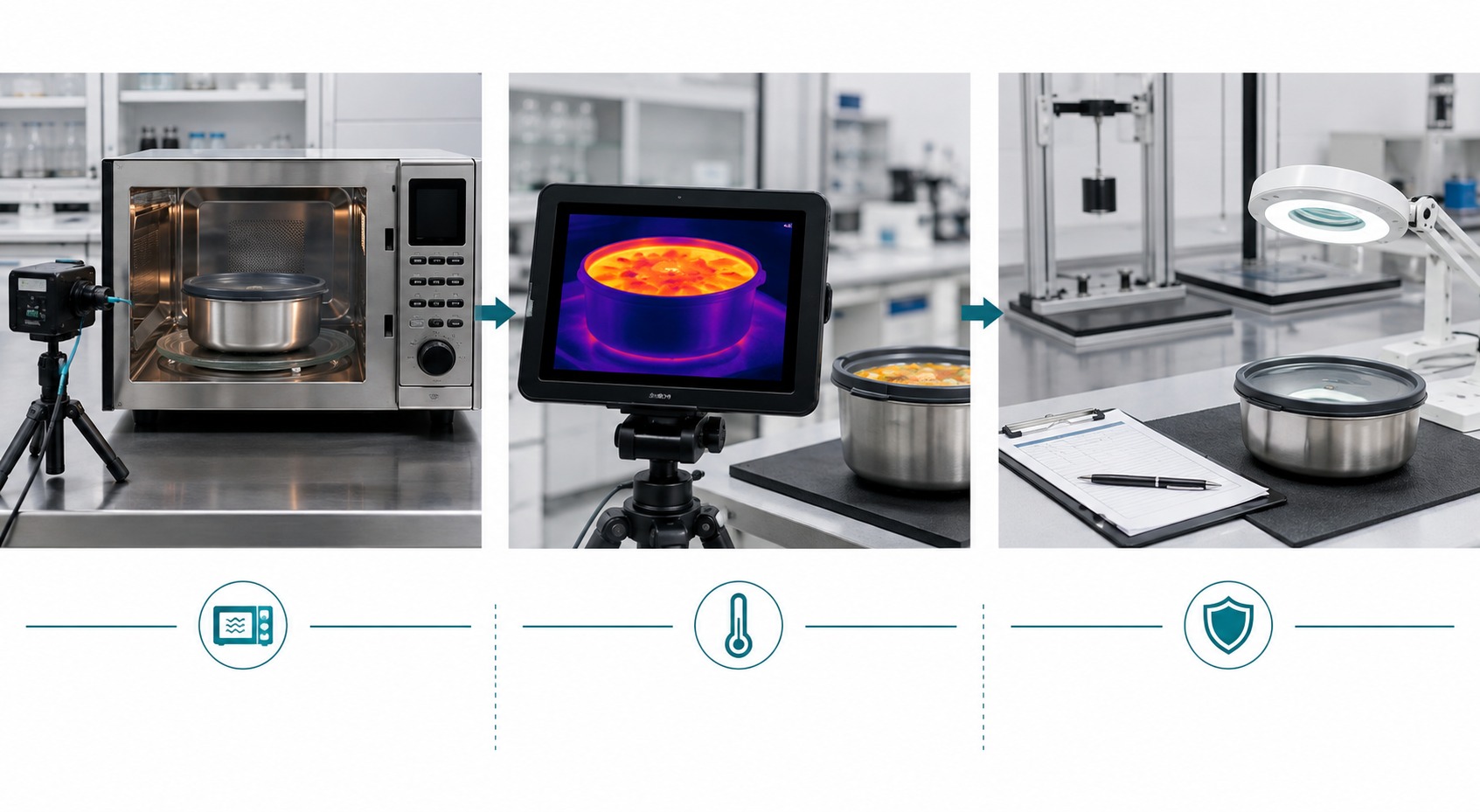 Figure 3. Validation should cover electromagnetic safety, temperature rise and uniformity, food-contact suitability, instructions, and retesting after durability conditioning.
| Validation layer | Typical checks | Signals of failure |
|---|
| Electromagnetic safety | Multiple oven types, powers, positions, loads, durations, and repeated cycles. | Arcing, abnormal light or sound, local erosion, melting, or oven damage. |
| Heating performance | Effective-power calibration, temperature curves, thermal imaging, uniformity, and standing time. | Cold spots, hot zones, poor efficiency, or excessive drying. |
| Heat and pressure | Body, rim, lid, and valve temperatures; steam release and opening behavior. | Burn risk, pressure buildup, splashing, or deformation. |
| Post-durability retest | Microwave testing after drops, abrasion, washing, corrosion, and seal-aging cycles. | Damaged rims, coating failure, or a changed conductive gap. |
| Food contact | Material identification and migration or odor testing for metal, coatings, silicone, and polymers. | Excess migration, odor, or material degradation. |
| Instructions and labeling | Representative users follow the real instructions; warning visibility is checked. | Likely misuse of the lid, excessive time, stacking, or wall contact. |
Table 2. A practical validation matrix. The final program must reflect the target market, material system, product design, and stated operating conditions.1. Arcing and oven safety: more than one oven and one short cycle
Testing should begin with calibration of the oven’s effective delivered power, then cover the allowed power, duration, container size, food load, and placement. A robust engineering program also considers different cavity constructions, turntables or flatbeds, food moisture and salt content, hot and cold starting conditions, and repeated heating. Observations include sparks, sustained arcs, abnormal sounds, localized burning, discoloration, melting, and any damage to the oven.
2. Heating performance and burn risk: no sparks is not enough
The food must reach the intended temperature without unacceptable cold spots, local boiling, or severe drying. Thermal imaging, multiple temperature probes, standing time, and before-and-after stirring measurements help reveal nonuniformity. The body, rim, lid, and valve also need temperature checks so that users can remove the box, release steam, and open it safely.
3. Retesting after aging: scratches, drops, and dishwashing can change the boundary
A smooth new sample does not prove that a year-old container will remain smooth. A drop can lift a rolled edge; abrasive cleaning can create deep scratches; dishwashers and detergents can affect coatings and seals. A sensible durability plan repeats microwave safety and temperature testing after drop, abrasion, washing, corrosion, and seal-life conditioning instead of treating mechanical and electromagnetic tests as unrelated.
4. Food-contact and labeling validation: safety is more than a spark test
Metals, coatings, silicone, and plastics that contact food must be suitable for the intended temperature, food type, and contact time. FDA guidance for food-contact submissions explains that migration testing for microwave-only or dual-ovenable containers should account for food composition, heating time, mass and shape, and container geometry—especially when polymers or coatings are involved. The final instructions must also communicate maximum power and time, lid handling, minimum load, one-container rules, and retirement criteria. [11]
5. How Consumers Should Decide—Without “Trying It Once”
• Look for an explicit claim for the exact model. Find “microwave-safe” on the container, packaging, or official manual; do not transfer a claim from another product in the same brand.
• Check every operating boundary. Confirm maximum power, single-cycle and cumulative time, minimum food load, lid and valve handling, and whether frozen-start heating is permitted.
• Read the microwave manual too. Some ovens impose additional limits on metal containers, metal racks, or minimum spacing. Both sets of instructions must be satisfied.
• Use one container, centered. Do not place it against the cavity wall, stack it, or microwave it beside a fork, metal cup, or second metal box.
• Stop immediately if you see sparks or hear crackling. Switch the oven off and move the food to glass or clearly microwave-safe ceramic. Do not continue “just to see what happens.”
• Retire damaged containers from microwave use. Deep scratches, lifted rims, deformation, peeling coatings, or loose attachments can change the validated electromagnetic condition.
• Do not self-certify an unmarked metal box with a one-minute water test. A short trial cannot cover geometry, spacing, food load, power, duration, oven variation, or aged condition.
6. Three Common Questions
The microwave cavity is metal. Why does it not spark?
The cavity is a continuous, grounded shielding structure designed around the electromagnetic field. Its surfaces, seams, and door are controlled. A lunch box is a new, movable conductor that may introduce sharp edges, narrow gaps, or close approaches to the wall, so the two situations are not equivalent.
Can a microwave-safe stainless steel box heat more slowly than glass?
Yes. Energy enters mainly through the opening; the metal sidewalls and base shield direct microwave penetration, so thicker food layers can create cold spots. Steel can spread heat laterally, but it does not transmit microwaves. Follow the instructions for staged heating, stirring, and standing.
If a stainless steel bowl has no sharp corners, is it safe?
No. Rounded geometry is important but not sufficient. Size, thickness, opening ratio, distance from the cavity wall, surface condition, food load, power, and time all matter. Without an explicit manufacturer claim and targeted validation, treat the item as not microwave-safe.
Conclusion
The decisive difference is not ordinary steel versus a mysterious “microwave-transparent” steel. It is an ordinary storage product versus a complete container system engineered to control electric-field concentration, give energy a workable path into the food, remain stable after use and cleaning, and communicate validated limits. When the exact model and both manuals permit it, follow those limits precisely. Otherwise, use glass or microwave-safe ceramic.
Sources and Evidence Boundaries
This article explains engineering principles and does not replace the instructions for a specific container or microwave oven. Standards describe test frameworks; manufacturer documents establish limits only for the named products; and patents describe possible design routes rather than proving that all products use or have validated the same construction.
[1] Why can’t we put metal objects in a microwave?. MIT School of Engineering. A concise explanation of metal reflection, edge-field concentration, and arcing.
[2] Theoretically and experimentally investigation of sparking of metal objects inside a microwave oven. University of Southampton ePrints / PIERS 2009. Theoretical and experimental work on metal disks, sharp edges, and sparking.
[3] Cooking with Microwave Ovens. USDA Food Safety and Inspection Service. Guidance on metal shielding, metal trays, and what to do if arcing occurs.
[4] US4560850A: Container with steam port for use in microwave ovens. Google Patents. A design route using rounded geometry, smooth walls, coatings, and edge insulation.
[5] WO2016098038A1: Microwave safe container. Google Patents. A design route using a metal inner vessel, microwave-transparent outer layer, controlled spacing, and a smooth rim.
[6] Bentgo MicroSteel Heat & Eat Container. Bentgo. Product materials, silicone lid and valve, and stated power and time limits.
[7] Bentgo MicroSteel Heat & Eat Container User’s Manual. Bentgo. Official warnings, including use of only one microwave-safe stainless steel container at a time.
[8] Cuitisan Help Center. Cuitisan Hong Kong. Official instructions covering single-container use, wall clearance, lid handling, time limits, and damage.
[9] Can this aluminum tray be used in the microwave? The answer is in standard NF D21-314. AFNOR. Overview of the metal-container standard and its safety, performance, and instruction requirements.
[10] NF D21-314. AFNOR Editions. 2023 standard for evaluating the microwave-heating suitability of metal and alloy food-contact articles.
[11] Preparation of Premarket Submissions for Food Contact Substances: Chemistry Recommendations. U.S. Food and Drug Administration. Food-contact migration considerations for microwave-only and dual-ovenable containers.