Why Can 304 Stainless Steel Become Magnetic After Deep Drawing?
Phase transformation, local strain, and what magnetism really means
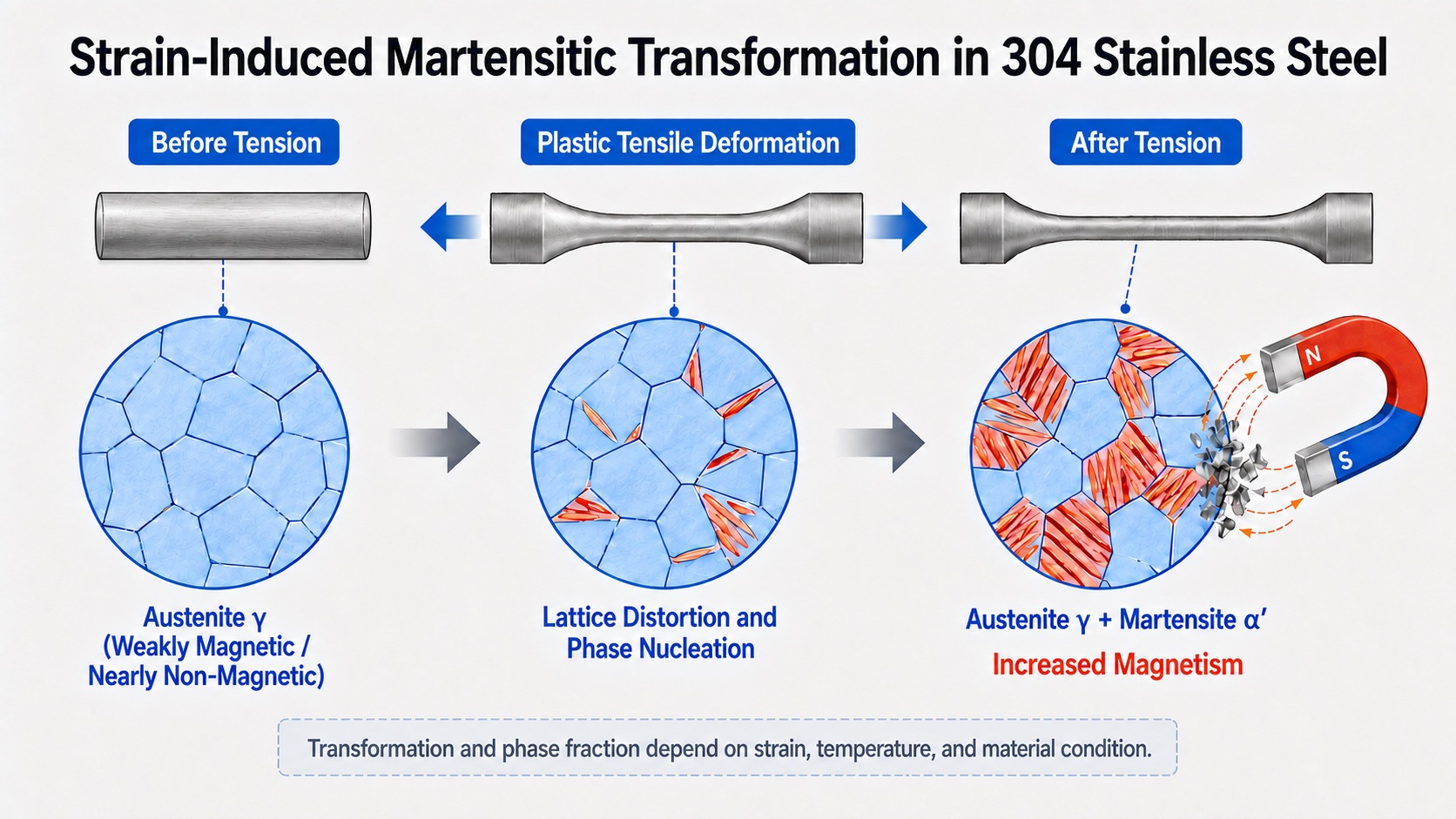
Figure 1. Cold working transforms some metastable austenite into deformation-induced martensite. These transformed regions are the main source of the magnetic response (schematic).
Bottom line: In the solution-annealed condition, 304 stainless steel is predominantly austenitic and only weakly magnetic. Deep drawing imposes severe cold plastic deformation, which can transform some metastable austenite into ferromagnetic α′ martensite. The finished part may therefore attract a magnet—often more strongly in some areas than others. This effect alone does not prove that the material is not 304.
1. Why Is 304 Usually Almost Non-Magnetic?
304 is an austenitic stainless steel. After solution annealing, its room-temperature structure is mainly face-centered-cubic γ austenite, with relative permeability close to 1. An ordinary magnet therefore produces little noticeable pull, so annealed 304 is often called “non-magnetic.”
That description is not absolute, and magnetism does not define the grade. Composition, residual ferrite, prior cold work, geometry, and the test magnet can all affect the observed response.
2. What Does Deep Drawing Change Inside the Material?
Deep drawing subjects the sheet to tension, compression, bending, reverse bending, and shear as it moves between the punch, die, and blank holder. These loads create large local plastic strains. Because 304 austenite is metastable at room temperature, enough deformation can transform some γ austenite—directly or through ε martensite—into α′ martensite.
α′ martensite is ferromagnetic. As its fraction rises, susceptibility and relative permeability increase, so a previously almost non-magnetic sheet may show mild or moderate attraction after forming. Magnetic permeability can therefore serve as an indirect indicator of deformation-induced martensite.
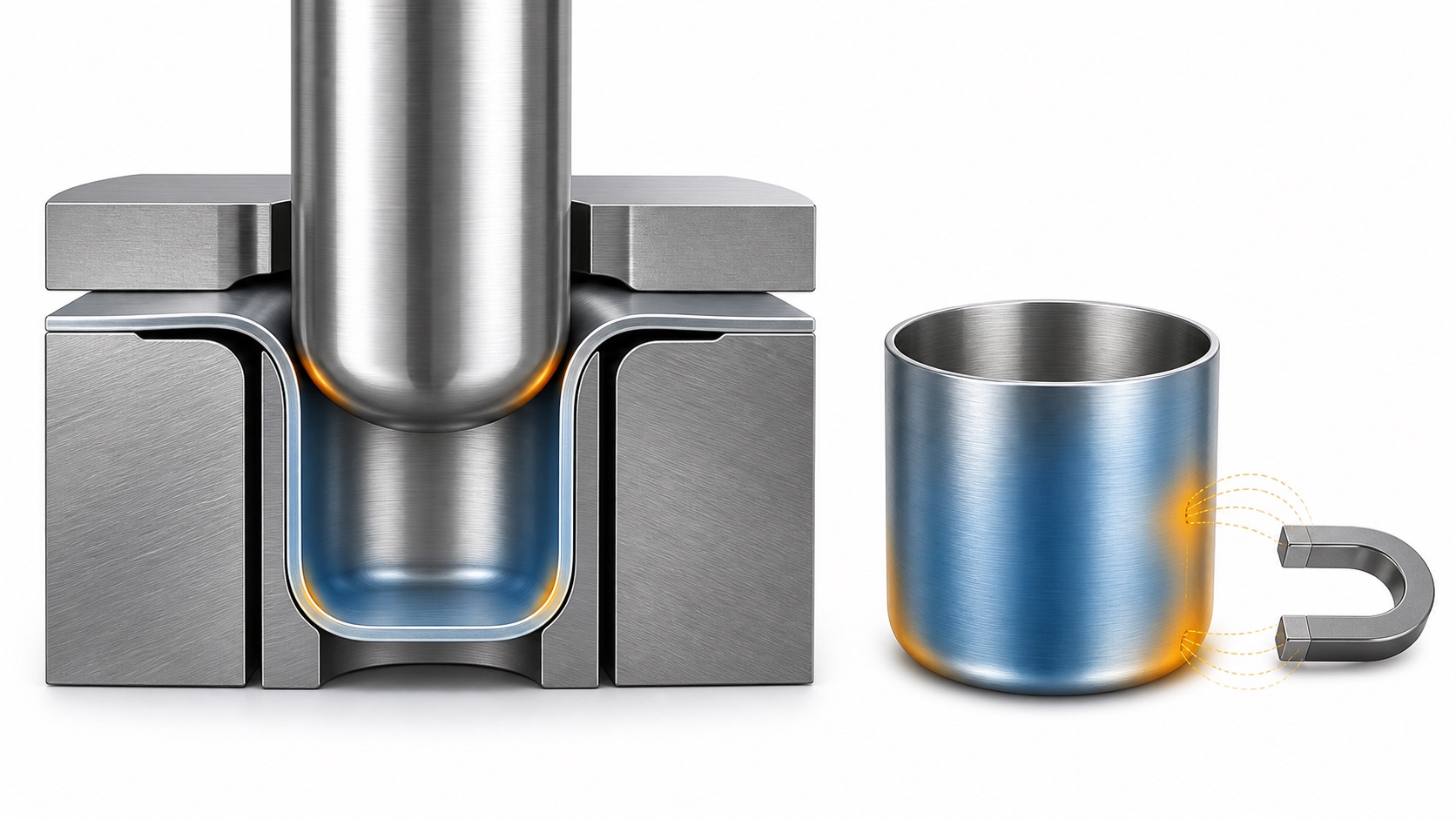
Figure 2. Deep drawing produces nonuniform strain. Radii, walls, and other high-strain zones are more likely to show a detectable magnetic response (schematic).
3. Why Does Magnetic Attraction Vary Between 304 Parts?
Amount of deformation: A higher drawing ratio, additional redraw or sizing operations, and greater local thinning generally promote more deformation-induced martensite.
Stress state: Uniaxial tension, biaxial tension, compression, and shear do not drive the transformation equally. Stress paths vary across a drawn part, so the magnetic response often varies by location.
Temperature: Lower forming temperatures generally favor martensite formation, while higher temperatures stabilize austenite. High-speed forming also generates plastic heat, so faster forming does not automatically mean stronger magnetism.
Heat-to-heat chemistry: Two heats can both meet the 304 specification yet have different combinations of nickel, chromium, carbon, nitrogen, and manganese. Their austenite stability—and the amount of martensite formed—can differ substantially.
Initial condition: Annealing condition, grain size, rolling history, residual stress, and any prior cold work all influence the later transformation.
Test method: Magnet strength, contact area, surface curvature, and wall thickness all affect the perceived pull. Local attraction does not mean the entire component has the same magnetic properties.
4. Why Are the Cup Radius and Sidewall Often More Magnetic?
Strain is not distributed uniformly in a deep-drawn part. The punch radius undergoes bending, reverse bending, and tension; the sidewall carries load and may thin; and the die radius and flange experience material flow, circumferential compression, and friction. These high-strain or complex-stress zones tend to form more α′ martensite.
Magnet pull can vary from the cup bottom to the radii, wall, and rim. This reflects the forming history; quantification requires calibrated permeability, ferrite-meter, eddy-current, or X-ray diffraction measurements.
5. Does Magnetism Mean the Material Is Not 304—or Is Poor Quality?
No. A magnet reveals only a magnetic response; it does not provide a chemical analysis and cannot reliably distinguish 304 from other austenitic grades or from material processed in a different way. Mild magnetism after deep drawing may simply be the normal result of deformation-induced transformation.
Magnetism and corrosion resistance are not linked one-to-one either. Grade 304 relies on a chromium-rich passive film for corrosion resistance, while cold work, surface contamination, welding, the service medium, and temperature all affect real performance. Whether a part attracts a magnet is not enough evidence to judge grade authenticity, corrosion resistance, or acceptance.
6. How Should Purchasing or Quality Teams Verify the Material?
Different questions require different evidence. Choose the test method according to the decision you need to make:
| Question | Recommended method | What it can tell you |
|---|
| Quick shop-floor screening | Compare several areas with a small magnet | Relative attraction only; it cannot confirm the grade |
| Confirm grade and chemistry | MTC plus PMI; use OES when needed | Checks elements such as Cr and Ni; low-carbon distinctions require the right method |
| Confirm magnetic performance | Calibrated relative permeability or dedicated magnetic testing | Comparable data suitable for an acceptance criterion |
| Confirm transformation and distribution | XRD, metallography/EBSD, ferrite meter, or eddy current | Estimates α′ martensite and its spatial variation |
Note: PMI commonly refers to portable material identification. XRF is useful for screening many alloying elements, but questions involving carbon content or distinctions such as 304 versus 304L may require OES or another suitable method.
7. Can the Magnetism Be Removed?
Appropriate re-austenitizing or solution heat treatment can reverse α′ martensite and reduce magnetism. Finished parts, however, may distort, oxidize, or change dimension and surface condition; cooling and corrosion requirements also matter. Local flame heating is not a reliable “demagnetizing” method.
Mild magnetism usually needs no remedy unless a low-permeability limit applies. For precision instruments, strong magnetic fields, or vacuum equipment, control chemistry, annealing, forming temperature, and strain during design, then measure the final part quantitatively.
8. How Can Magnetic Response Be Reduced Before and After Forming?
In production, the practical target is usually to reduce magnetic response or restore low permeability—not to guarantee absolute “non-magnetic” behavior. Post-forming treatment can help, but material and process choices made before drawing are often more predictable and economical.
Post-forming and process options
| Option | Expected effect | Main advantage | Limitations & relative cost |
|---|
| Solution annealing / re-austenitizing | Usually the most effective; reverses much of the deformation-induced α′ martensite | Acts on the bulk microstructure and offers the largest potential reduction | May cause distortion, oxidation, and dimensional change; pickling/passivation may follow. Cost: High |
| Intermediate annealing between drawing stages | Reduces accumulated cold work and the final magnetic response | Improves formability and is useful in multi-stage drawing | Adds energy, handling, and cycle time. Cost: Medium–High |
| Warm forming / controlled forming temperature | Suppresses martensite formation during forming | Prevents the problem and may avoid final heat treatment | Requires more complex tooling, lubrication, and temperature control. Cost: Medium |
| AC demagnetization | Reduces remanent magnetization only | Fast, inexpensive, and has little dimensional impact | Does not remove α′ martensite or reduce intrinsic permeability. Cost: Low |
| Local flame / induction heating | Local and often nonuniform | Can target a limited area | Risk of distortion, oxidation, and microstructural gradients; unreliable for formal acceptance. Cost: Medium |
| Pickling, passivation, or electropolishing | Little effect on bulk magnetism | Improves cleanliness, surface condition, or corrosion performance | Does not reverse internal martensite; not a true demagnetizing treatment. Cost: Medium |
Material and process choices before drawing
For demanding low-permeability applications, consider more stable austenitic grades. Type 305 is often preferred for deep drawing; 316/316L generally resists deformation-induced martensite better than ordinary 304, but costs more.
Do not assume 304L is automatically less magnetic. Its low carbon content primarily addresses welding and intergranular-corrosion concerns, not guaranteed post-drawing permeability.
Specify fully annealed material with minimal prior cold work. Where necessary, control the chemistry window or obtain a supplier permeability guarantee; higher nickel and nitrogen contents generally stabilize austenite.
Optimize draw ratio, tooling radii, number of stages, and local thinning. Use intermediate annealing or warm forming when the part geometry and acceptance limit justify the added process cost.
Put a relative-permeability requirement on the drawing or purchase specification and measure the final component. Magnet pull alone is not an acceptance method.
Practical priority: Preventing martensite formation through grade selection and process design is usually more stable and economical than trying to remove magnetism after the part is finished.
Conclusion
The key point is that deep drawing changes the microstructure—not the name of the material. Severe local plastic deformation converts some metastable austenite into ferromagnetic α′ martensite. Strain, temperature, stress state, composition, and initial condition together determine the strength and distribution of the response. When material identity is disputed, treat a magnet as a clue—not a verdict.
References
S. S. Hecker et al. (1982). Effects of Strain State and Strain Rate on Deformation-Induced Transformation in 304 Stainless Steel: Part I.
S. Gallée and P. Pilvin (2010). Deep Drawing Simulation of a Metastable Austenitic Stainless Steel Using a Two-Phase Model.
B. Cao and T. Iwamoto (2017). An Experimental Study on Strain-Induced Martensitic Transformation in SUS304 by Real-Time Measurement of Relative Magnetic Permeability.
A. Mészáros et al. (2014). Reverse Transformation of Deformation-Induced Martensite in Austenitic Stainless Steel Studied by Positron Annihilation.
R. B. Goldfarb et al. (1984). Magnetic Susceptibility and Strain-Induced Martensite Formation at 4 K in Type 304 Stainless Steel. National Institute of Standards and Technology (NIST).